Checklist: Sourcing hotel lighting from China
Hotel lighting procurement often combines custom finishes, varied fixture types, controls, installation interfaces, and phased project dates. Sourcing should connect the design schedule to supplier capability, technical evidence, mockup approval, production controls, and site delivery. A checklist helps the buyer avoid selecting a supplier based only on a catalog image or unit price.
Key takeaways
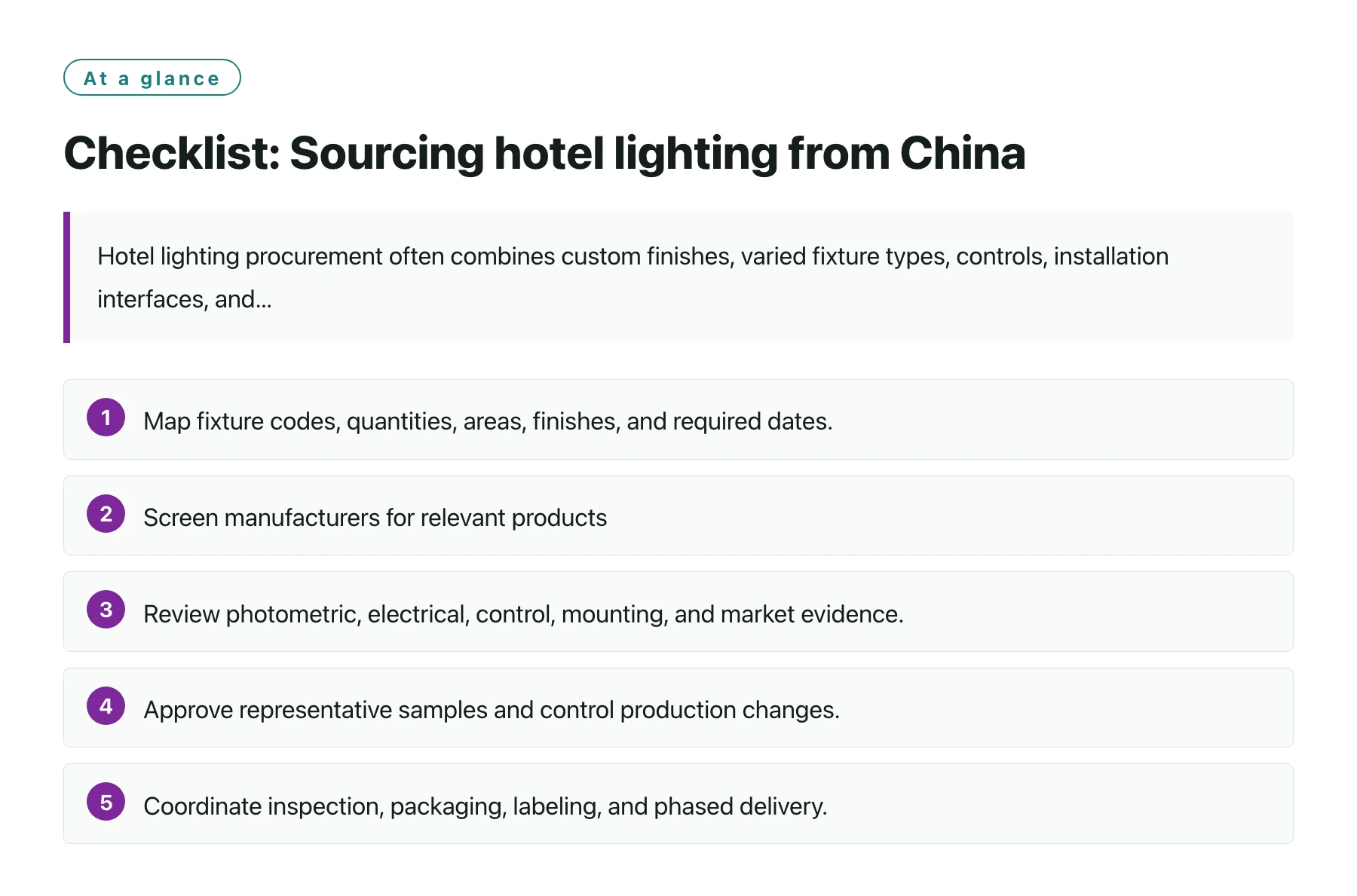
- Map fixture codes, quantities, areas, finishes, and required dates.
- Screen manufacturers for relevant products, components, and export capability.
- Review photometric, electrical, control, mounting, and market evidence.
- Approve representative samples and control production changes.
- Coordinate inspection, packaging, labeling, and phased delivery.
Use the project fixture schedule as the organizing record for suppliers, samples, technical evidence, orders, and room-by-room receipt.
1. Build a complete fixture schedule
List fixture code, room or area, quantity, mounting, output or distribution need, finish, control, voltage, accessories, drawing reference, and delivery phase. Identify custom, long-lead, exterior, and life-safety-related items. Link every supplier response to the same schedule revision.
Mark design approvals and technical review owners. Separate required performance from preferred appearance or price. Record site conditions, ceiling type, access, control system, and any interface with electrical or building management systems.
2. Identify suitable manufacturers and actual production roles
Search for suppliers with relevant fixture types, finish processes, driver sourcing, optics, assembly, and project scale. Ask for legal entity, factory site, export role, engineering contact, and subcontracted operations. Verify the proposed seller and production site rather than relying on a showroom brand.
Request product references or examples tied to actual fixtures and project context. Determine whether the supplier can manage mixed schedules and custom finishes or mainly offers standard catalog products. Clarify who will coordinate component availability and change notices.
3. Issue consistent requests for information and pricing
Send a controlled fixture schedule, drawings, finish requirements, destination, packaging, submittal needs, sample deadlines, and delivery phases. Ask suppliers to confirm each model, list deviations, identify included driver and controls, and state quote validity and lead time.
Require separate pricing for fixture, options, tooling, samples, mockups, spares, packaging, documentation, and freight. Define how alternatives will be described and compared. Missing details should remain open rather than being assumed included.
4. Review photometric and application data
Request photometric files or test reports for the exact optics, source, driver, and fixture configuration. Have the lighting designer check distribution, output, color characteristics, glare, and dimming against the room design and control approach. Confirm whether the evidence represents the quoted configuration.
Record performance assumptions such as ceiling height, mounting, lens, dimming level, and accessories. Marketing data may use different conditions from the project calculation. Ask suppliers to explain exceptions and do not treat a generic chart as approval for all configurations.
5. Check electrical, control, and market requirements
List voltage and frequency, driver, dimming protocol, wiring, sensor or emergency interface, connector, and control-system requirements. Ask for diagrams and confirm compatibility with the project integrator. Identify who supplies gateways, software, commissioning, and programming.
IEC 60598-1:2024 covers general requirements and tests for luminaires within its scope. Determine applicable parts and destination-market obligations with qualified project reviewers; citing one standard does not establish that every offered model or configuration is suitable. [1]
6. Evaluate finishes, samples, and mockups
Request physical finish samples and representative fixtures with the proposed optics, driver, trim, and mounting. Label each with model, revision, date, and supplier. Compare under project lighting and with adjacent materials when appearance is critical.
Define what sample approval means and which characteristics it covers. A finish board may approve color without approving photometric performance, controls, or electrical evidence. Use mockups to assess scale, glare, beam effect, installation fit, and control behavior, then document decisions and conditions.
7. Review quality and production controls
Ask how suppliers control incoming drivers, LED modules, optics, housing, coating, wiring, assembly, functional checks, and final labeling. Request traceability and inspection records for comparable production. Determine who checks component substitutions and how approved revisions reach operators.
Set pre-production, in-process, and final checks proportionate to risk. Define sample basis, criteria, report fields, defect severity, corrective action, and shipment release. A passed sample or factory audit alone does not prove every delivered fixture matches the approved schedule.
8. Compare lead times and phase deliveries
Build a schedule for submittals, finish approval, sample or mockup, component procurement, production, inspection, packing, and site delivery. Identify dependencies such as final room dimensions, control approvals, or custom finish signoff. Ask for lead times by fixture family rather than one package-wide estimate.
Plan partial releases around installation needs and site storage limits. Confirm whether early goods can be held safely and how later phases remain consistent in finish and components. Record trigger dates and escalation paths for late materials or factory capacity conflicts.
9. Define packaging, labels, and shipment handoffs
Specify carton and pallet protection, labels by fixture code and room, accessory segregation, lot identification, and handling instructions. Ensure package marks can be read after wrap and match the packing list. Confirm who arranges transport, insurance, export documents, and destination delivery.
Check damage-sensitive optics and finish protection before shipping. Include inspection photographs and loading records where useful. At receipt, reconcile quantities, identify damaged cartons, quarantine questionable goods, and preserve labels for claims or supplier corrective action.
10. Make a documented sourcing decision
Compare design fit, technical evidence, supplier role, quality controls, lead time, phase flexibility, total cost, service, spares, and open deviations. Screen mandatory project requirements first. Record approved model, driver, optics, finish, controls, documents, and exceptions in the purchase order.
Buyers seeking hotel lighting sourcing can coordinate fixture schedule, supplier evidence, samples, quality checks, and deliveries through one controlled file. Reopen technical approval after any change to optics, source, driver, controls, mounting, finish, or factory.
Sources
Frequently asked questions
Can a catalog fixture be sourced without project review?
Only after matching its exact configuration, controls, mounting, evidence, finish, and schedule to project requirements.
Should suppliers quote by fixture code?
Yes. Use the schedule code and revision so models, options, quantities, and phases can be reconciled.
What does a lighting mockup help evaluate?
It can show scale, finish, glare, beam effect, mounting, and control behavior under stated conditions.
When should fixture approval be repeated?
Repeat review after changes to optics, driver, source, controls, mounting, finish, factory, or other approved details.