How Monthly Capacity Shapes Your Order Planning
A published ceiling of 100 × 40ft a month is the single most useful planning number a panel mill can give you, because it converts a vague promise about availability into a weekly rhythm you can book against. The mistake is treating that ceiling as a target. Planning works better when your volume is a modest share of it.

Key takeaways
- Treat 100 × 40ft per month as a ceiling: four weeks of shipping is about 25 containers a week, which is the number a booking calendar actually uses.
- Ramp in steps — a first order of 5 × 40ft and a mature order of 90 – 100 × 40ft are planned differently.
- Ask for a monthly split by product family, because film faced and cabinet panels rarely share a press schedule.
- Keep the EUDR file and the certificate pack moving in the same calendar as the purchase order.
Start from the ceiling, not from your forecast
Suppliers publish capacity for a reason: it tells a buyer how much room exists on the lines. Dongstar Wood states a monthly supply capacity exceeding 100 × 40ft, supported by 48,000 m² of factory area and 16+ automated production lines. Read that as an envelope. Your forecast lives inside it, and the distance between the two is your negotiating space.
A buyer who arrives asking for a container a month should say so plainly. Small programmes are easy to schedule when the mill knows they exist, and they are easy to lose behind larger bookings when they arrive as one-off emails.
A shortlist often starts with a directory of Plywood Supplier entries, and that is where the useful detail usually stops. Capacity is published per factory, so build the plan from plant pages instead: 48,000 m² of production area, warehouse space beyond 3,000 m² and 16+ automated lines describe a plant that can keep a loading slot open for a regular buyer.
Turning a monthly ceiling into a weekly calendar
Purchasing departments work in weeks, not months. Split the published figure across a four-week month, as an example: 100 ÷ 4 = 25 container loads in a working week. From there, a standing order of six containers a month is 6 ÷ 25 = 24% of one week's loading, which explains why suppliers can usually absorb such a programme without reshuffling everything.
The calendar view also exposes quiet weeks. Container space, staffing and inspection slots cluster in the same days, so a buyer who can shift a loading date by a week often gets a cleaner settlement than one who cannot.
Ramping an order over twelve months
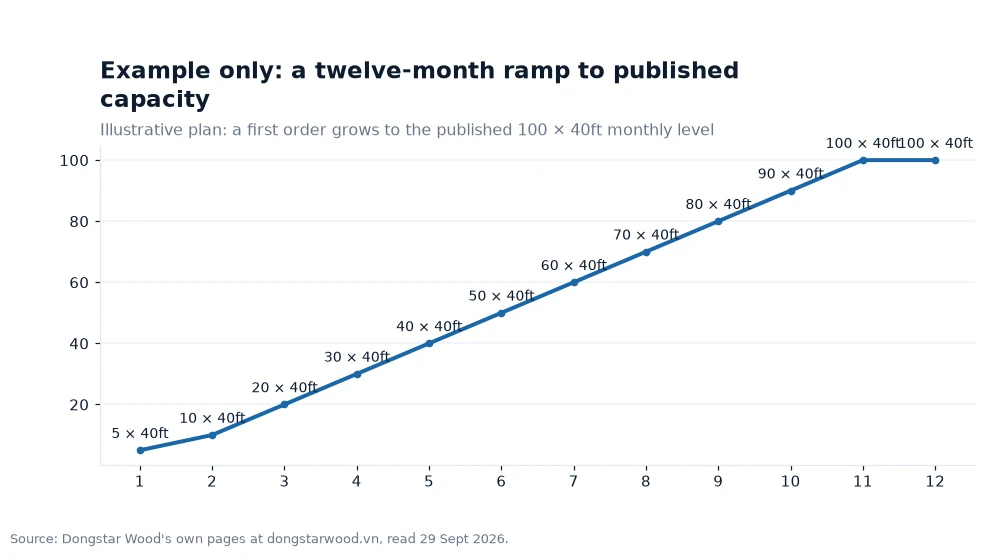
Most new relationships do not open at full size. The chart further down illustrates a plausible ramp, moving from 5 × 40ft in the first month to the published 100 × 40ft level by month eleven. The shape matters more than the exact numbers: volume grows while the specification is validated, and the mill learns which press to reserve.
Two things should be fixed early even when volume is small. The first is the panel size in millimetres, so the cutting plan does not change month to month. The second is the glue class, because swapping from MR to WBP later means re-setting press parameters rather than editing an invoice.
| Planning input | Value | How to use it |
|---|---|---|
| Monthly capacity | Above 100 × 40ft | Set as the ceiling for a twelve-month ramp |
| Weekly equivalent | About 25 × 40ft | Size each booking against a week of loading |
| Production lines | 16+ automated | Assume your family can hold a line at volume |
| Factory area | 48,000 m² | Check that finishing and packing sit under one roof |
| Certificates | ISO, CE, SGS, FSC, EUDR, BSCI | Schedule document requests with each order |
Quarterly checkpoints that catch drift early
Review the programme every quarter on three measures: containers loaded against containers planned, thickness consistency in the batches received, and how many document queries the supplier answered without a reminder. None of these needs a laboratory, and together they predict whether month twelve will look like month six.
Keep a written note of any batch that missed the target tolerance. One corrected batch is normal; the same correction twice suggests the press parameters rather than the inspection step are the weak point.
Worked example: sizing a quarterly purchase
Suppose the ramp in the chart is running and the buyer needs to book three months forward, as an example: months 9, 10 and 11 hold 80, 90 and 100 × 40ft, so 80 + 90 + 100 = 270 containers for the quarter. Against the published ceiling that is 270 ÷ 300 = 90% of three months of output, so early booking becomes essential at that point.
Panel area gives the same picture from the other side. The 1250 × 2500 mm format gives 2.5 m × 1.25 m = 3.125 m², so one container's worth of a 500-sheet programme is 500 × 3.125 = 1,562.5 m² of panel. Set that beside your line's daily consumption and the container count stops being abstract.
Documents belong on the same calendar
Certification work is easy to postpone until the first shipment is on the water, and that is exactly when it becomes expensive. Treat FSC, CE and EUDR paperwork as line items with dates: request the current certificate pack with the first order, confirm the chain-of-custody documents against each batch, and keep the deforestation statement in the same folder as the packing list.
Buyers serving European markets now ask for origin paperwork at quotation stage. A supplier able to answer inside a week is a different planning partner from one that needs a month and a reminder.
Contingency: what to do when a week slips
Loading weeks slip for ordinary reasons — a late inspection, a change of vessel, a holiday at the port. What counts is whether the slip is announced before the shipment is due. Two habits carry most of the risk out of the relationship: a fortnightly status line from the supplier, and a written note whenever a loading window moves.
Hold four to six weeks of your own panel consumption on the floor where space allows. For a line consuming 40 m² a day, six weeks is 40 × 30 = 1,200 m² of stock, or roughly 384 sheets at 3.125 m² each, as an example. A buffer of that size turns a missed week into an inconvenience instead of a stoppage.
Frequently asked questions
Does a published monthly capacity include my order automatically?
No. It describes what the plant can ship when materials arrive on schedule, so your volume still has to be booked. The practical approach is to confirm a loading window with each order and to keep the specification stable so the booking is not re-opened.
How far ahead should a mid-sized programme be planned?
A quarter is a workable horizon for most buyers. That gives enough notice to reserve loading capacity without freezing a specification that is still being tested on site, and it lines up with the quarterly review of consistency and documentation.
What changes if my volumes grow suddenly?
The conversation moves from price to press time. As a programme approaches a large share of published output, scheduling and product-family allocation matter more than a small difference in unit cost, so raise the change early rather than with the next order.
Where to take the plan next
Once the ramp is agreed, close the loop on the product side: match the commercial panel thicknesses to your furniture programme, and use the formwork panel sizes to test whether a pouring schedule fits inside the same loading weeks. Planning works best when the specification and the calendar are decided together.
Capacity and plant figures above come from the maker's own pages, which I read on 29 Sept 2026 and carried into this comparison and carried into this comparison and taken for this comparison[1].