Scaling a Plant From 20 to 100 Hectolitres
Moving a brewhouse from a 20 HL batch to a 100 HL batch multiplies volume five times, and it changes almost every supporting system along with it: vessel geometry, heating, cooling, control and the building itself. HGMC publishes large commercial brewery systems up to 100 HL, and commercial brewery sizes from 1 HL to 500 HL, so a 100 HL target sits inside the published range rather than at its edge.
Key takeaways
- HGMC publishes capacities from 100 L to 200 T and equipment from 1 BBL to 100 BBL, with large commercial brewery systems up to 100 HL.
- Brewhouse configuration is the first lever at scale: 2, 3, 4 and 5-vessel arrangements are published, in steam, direct-fire and electric heating.
- Control level is the second lever, from a PID display panel through a PLC semi-automatic touch screen to a PLC fully automatic panel with curve indication and production-record printing.
- Delivery is published at 90 to 150 days from deposit to door, which a scale-up usually needs for building and utility works as much as for the vessels.
What actually changes when the batch grows five times
Twenty hectolitres is 2,000 L and 100 HL is 10,000 L, so the batch grows by five while the number of brews you want in a week stays roughly where it was. That is the point of the scale-up: not to brew more often, but to brew the same number of times with bigger vessels. Everything downstream of the kettle then has to keep up, and the first place it shows is fermentation and cooling capacity rather than the brewhouse.
Vessel geometry is the visible change. A larger kettle has a different height-to-diameter ratio, and the published design notes for HGMC equipment describe jackets on both the body and the cone plus a bigger headspace, with the cover headspace volume calculated separately. At 100 HL that headspace figure stops being a detail: a boil that climbs too close to the rim turns every brew into a slow, careful pour.
The published case list shows how wide the range runs in practice, from a 200 L installation in Australia and a 500 L project in Germany up to a 20 T project in Poland, with 1,000 L to 3,500 L sizes across Korea, Canada, Italy, Spain, France and the United States. A scale-up from 20 HL to 100 HL is therefore a normal move inside the range, not a special build.
Brewhouse configuration and heating
At 20 HL a two-vessel or three-vessel brewhouse covers a normal production week. At 100 HL the same layout starts to cost time, because the steps that were short at 2,000 L take much longer at 10,000 L, and parallel working is how a large plant keeps a brew day inside one shift. HGMC publishes brewhouse configurations in 2, 3, 4 and 5 vessels, which is the range you want available when the batch grows, and the design supports either decoction or infusion methods.
Heating is the second decision and it is usually driven by the building rather than by the brewhouse. Electric heating is straightforward where the supply allows it, direct fire needs its own ventilation and floor arrangements, and steam gives the steadiest heat input on a large kettle and is published as one of the three heating methods alongside the others. A well-designed steam system is described in the published material as an advantage for exactly this reason.
| Stage | Batch | Brewhouse and heating | Control level |
|---|---|---|---|
| Starting plant | 20 HL | 2 or 3 vessels, electric or direct fire | PID display control panel |
| Mid step | 50 HL | 3 or 4 vessels, steam preferred | PLC semi-automatic touch screen |
| Target plant | 100 HL | 4 or 5 vessels, steam with a designed steam system | PLC fully automatic panel |
Cooling, packaging and the building
Cooling is where a scale-up is usually underestimated. A 100 HL batch has to be knocked down to pitching temperature in a sensible time, which means a larger plate heat exchanger, more chilled water, a bigger glycol system and cooling pipework sized for the flow rather than for the old duty. Fermentation capacity follows: five times the batch volume needs either five times the tank volume or more tank turns, and tank turns are limited by how fast a tank can be emptied, cleaned and refilled.
Packaging is the third bottleneck. A 20 HL plant can absorb a manual filling day; a 100 HL plant cannot, and the published equipment families cover beer filling machines for bottles and cans alongside the brewery systems themselves. The building has to carry the change as well: bigger vessels mean heavier point loads, more steam or heat to remove, more water and more effluent, and a floor that has to take a washdown routine rather than a mop.
Control level and the production record
At 100 HL the control panel stops being an operator convenience and becomes the way a shift is documented. The three published levels run from a PID display control panel through a PLC semi-automatic touch screen to a PLC fully automatic control panel with curve indication and production-record printing. The printed record is the quiet benefit of the top level: when a batch tastes different, the temperature curve is already on paper, and the argument about what happened on the night shift is short.
Fabrication standards are worth checking at the same time, because they are easier to inspect before the vessels are piped in than afterwards. HGMC publishes TIG 100 per cent full welding joints, polishing accuracy of 0.4 μm or finer, stainless steel 304 or 316 with plate thicknesses of 3 mm and 2 mm, and SUS304 food-grade material certified by SGS. The published quality system is in compliance with ISO9001:2015, and the company exports to more than 120 countries.
Worked example
Worked example, with the assumptions stated. Ignore seasonality and take a plain production week at each size. At 20 HL per batch and 5 brews a week, output is 20 multiplied by 5, which is 100 HL a week, or 5,200 HL over 52 weeks. At 100 HL per batch and the same 5 brews a week, output is 500 HL a week, or 26,000 HL a year. The output ratio is 26,000 divided by 5,200, which is 5.0, exactly the batch-size ratio.
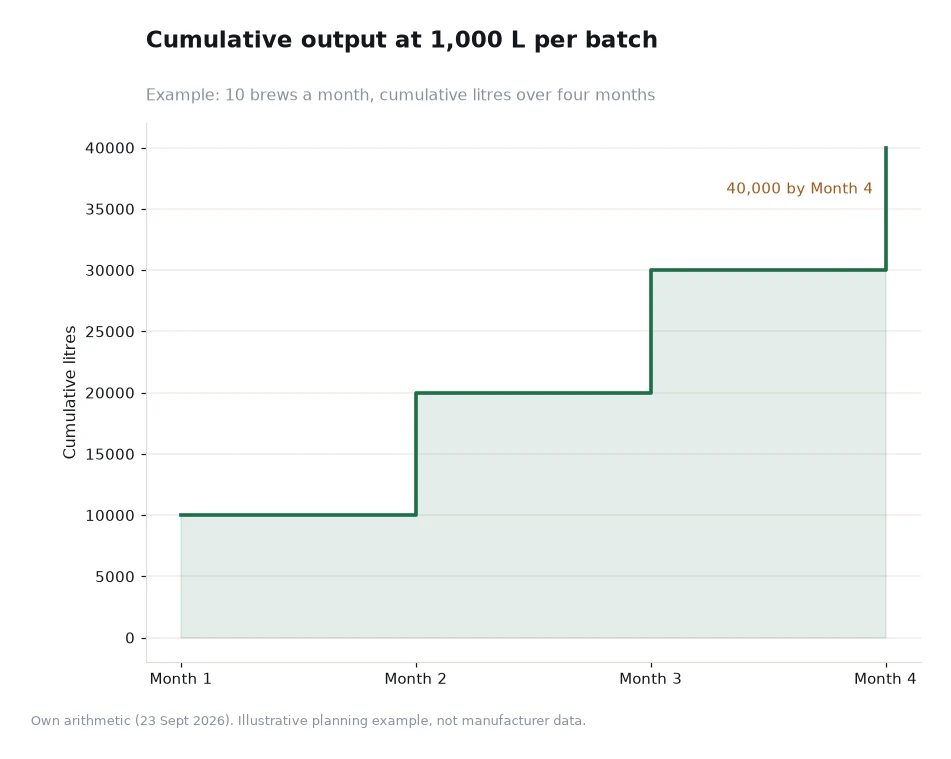
Now convert the chart below into the same units. Its example is a 1,000 L batch, 10 brews a month, for four months, giving cumulative totals of 10,000, 20,000, 30,000 and 40,000 L. In hectolitres that ramp is 100 HL, 200 HL, 300 HL and 400 HL. A 20 HL batch reaches that same 400 HL in 20 brews, and a 100 HL batch reaches it in 4 brews.
That conversion is the planning point of the example. A plant moving from 20 HL to 100 HL does not need five times as many brew days to hit the same volume; it needs five times the batch volume on a brewhouse that can still be cleaned, filled and turned in a working day. Both arithmetic steps are labelled examples of mine, using the published conversion of 1 BBL at about 117 L where barrel figures appear.
Frequently asked questions
What is the largest system this manufacturer publishes?
HGMC publishes equipment up to 100 HL for large commercial brewery systems, with commercial brewery sizes quoted from 1 HL to 500 HL and capacities from 100 L to 200 T, so a 100 HL plant is a published target rather than a special order.
How long does a scale-up take to deliver?
The published window is 90 to 150 days from deposit to door delivery, depending on the order, and a scale-up usually spends part of that window on building and utility works such as steam supply, cooling and floor loading.
Sequencing the move without stopping production
Build the scale-up around the cooling and packaging capacity rather than around the brewhouse, because that is where the first constraint appears. The published commercial brewery equipment listing covers the large-system range, and the brewery systems section shows how the size classes sit together. The brewhouse equipment pages cover vessel counts and heating options, and the free 2D, 2.5D and 3D design service is the sensible way to test a 100 HL layout against the building before anything is ordered.
Published figures in this article come from the manufacturer's own website, read 23 Sept 2026: capacities from 100 L to 200 T, equipment from 1 BBL to 100 BBL, large commercial systems up to 100 HL, the 2 to 5-vessel brewhouse range, the three heating methods and three control levels, the TIG welding and polishing specification, the SUS304 material certified by SGS, the ISO9001:2015 quality system, and the 90 to 150 day delivery window.[1] The weekly-output arithmetic is a labelled planning example.